Competitive Mindset
The competitive mindset transcends sport. It is a way of being, and some might even say it is genetic. I see it in recreational athletes, competitive age group athletes, professional athletes, not to mention coaches, educators, doctors, servers, hairdressers, new moms, guys having a beer, kids having a snowball fight. The list goes on. For the purposes of this discussion, we will focus on the athlete.
The competitive mindset is almost limitless in its brilliance and stupidity. I say this in the kindest of ways, because while the brilliance speaks to the ability to pursue with single-minded purpose – often accompanied by palpable intensity, creativity and grit – it is the stupidity of focus that with guidance, can be the game-changer, and without guidance, can be the destroyer.
The competitive mindset is necessary for society. We need people with this kind of perspective on life. These people dream of impossible things. They aspire. They strive. They succeed and they fail and do not stop until they achieve. And then, they begin again. They are not the only mindset we have or need in society, but they are ones that go beyond what we think is the outermost boundary in any realm.
Model of the Competitive Mindset
While some would state what they would think is the obvious – that the competitive mindset means the athlete is ‘competitive’ and only wants to ‘win’ – I would argue that this is too simplistic. For sure, many athletes with the competitive mindset want to ‘win’ and sometimes at any cost. Most typically we would see this in pro and competitive age group athletes. But, there are additional nuances to the competitive mindset that are essential for coaches, especially recreational age group coaches, to understand. I see the competitive mindset as a series of rings that overlap.
Figure 1 – Model of the Competitive Mindset
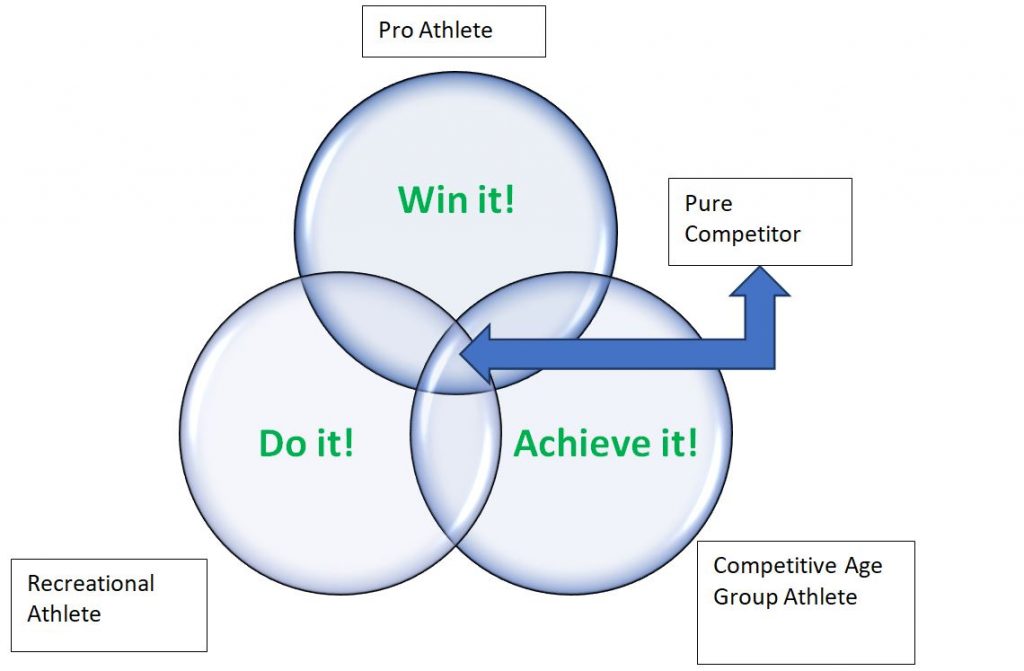
The purest competitor is the athlete in the center where the three rings overlap. This is the athlete who is driven to do, to achieve and to win, often at all cost, in every single thing he/she does. This can be a professional or competitive age group athlete. These athletes are rare, they become superstars and/or they experience major sport-ending injuries and move on to other realms of life. And, some of the most successful athletes can end up alienating many people along their journey to the top of the podium because of their intense focus on winning, without consideration for the importance of relationships and the recognition of the long-term, post-competitive transition that will eventually occur for them.
More commonly, the professional triathlete is found in the ‘win’ ring, the competitive age group triathlete in the ‘achieve it’ ring and the recreational triathlete is in the ‘do it’ ring. Keep in mind as I say this, though, that this is a model that is reflective of practice. Rarely does practice fit neatly or perfectly into a model.
The Characteristics of the Competitive Mindset
I have coached and been coached for many, many years, taught and been taught, led and been led. I have learned over and over about what I call the competitive mindset. In part, I have learned about myself. In large part, I have learned about others’ and about how to tap into their most precious and intense feelings and beliefs about their own power and potential.
Belief
- People with a competitive mindset believe in themselves, even though they often appear to manifest a lack of belief in their abilities. Despite often having huge inferiority complexes, people with a competitive mindset still carry a deep-rooted, more often than not completely subconscious belief in their own ability to overcome the odds. And, as well as they perform, it is never enough. The need to do it, achieve it, win it despite their frequently negative internal communication system. It’s part of their deoxyribonucleic acid (DNA).
Curiosity
- Athletes with a competitive mindset are curious – more curious than most. And this curiosity manifests in a variety of ways. Sometimes athletes do not know what they want to know about a situation or a performance, but they nonetheless look for meaning, purpose, understanding. In part this relates to the desire to be better, the best or the first and the urge to figure out how things work and what works best to achieve an end. This kind of curiosity is a powerful motivator!
- Another element of the curiosity is the desire to know what is possible. I have had athletes send me feedback after a scheduled 3km swim to say that they swam 6km just to see if they could do it. This kind of potential-based curiosity can be childlike it its naivete and joyful abandon. It can also be dangerous and lead to injury if not cultivated positively. Curiosity is an incredibly valuable characteristic to encourage and develop, especially in very competitive athletes. If this is done well in conjunction with the coach, athletes refine their curiosity to seek and to learn, in an ever-deepening circular cycle of understanding, which ultimately makes them much better competitors and human beings.
Boredom
- Often naturally gifted athletes get bored easily – both physically and mentally – if they are not challenged. If their curiosity is not cultivated, if their training is not varied in ways that support their ability to adapt and absorb the training, if their minds are not challenged with the questions of why do this, what is happening to my body, how do I know I am improving, the athlete can get bored easily, lose focus and go rogue. The coach’s greatest challenge with bored athletes is to inspire dialogue about the training, to connect athletes’ experiences to learning and performance changes, and to expand athletes’ perspectives to the point that triggers athletes’ curiosity. Essentially, the coach helps the athletes learn when lessons produce results that relate to being better. One caveat to this process is that for highly competitive athletes, the learning often must be epic, whether failure or success, for initial learning and curiosity to kick in. Moderate success or failure often does not register, and too much moderate activity will trigger boredom.
Fixation
- Highly competitive athletes can fixate – turn their laser sharp, often perfectly linear focus – onto anything with an intensity of the first order. They can fixate on goals, workouts, nutrition, people, venues – anything that is associated with or related to performance, other competitors, the ‘right’ gear, the best windspeed, the ritual that previously led to success – and not let a single thing break the straight line from where they are to where they want to be. This is a highly effective characteristic relative to keeping athletes engaged in the training toward the goal, and keeping the athletes fully immersed in the pursuit of the best performance. The flipside, however, is that if unchecked or misunderstood, the single-minded intensity of perspective can wreak havoc on relationships, performance and the well-being of everyone involved with the athletes.
Powerful Internal Communication System
- People with a competitive mindset have a very well-developed, precise and comprehensive internal communication system, complete with a thorough understanding of source/receiver, message building, encoding, decoding, filtering, communication channels, noise, context, realities and effect (Shockley-Zalabak, 2015). In addition, they have highly refined values, beliefs and attitudes about their own realities, deeply embedded in their subconscious and evident in their daily internal and external communication patterns. It is essential that coaches tap into the communication patterns and, using an understanding of the athletes, begin to infuse athletes’ communication systems with different language that effectively helps athletes communicate more positively with themselves (and others). This is one of the key reasons why feedback from the athletes and dialogue between the athletes and the coaches is so incredibly important.
Comparative Perspective
- People with a competitive mindset tend to work from a comparative perspective, whether the comparisons are among people, times, expectations, results, attitudes, orientations, etc. They compare, they assess, they analyze, set expectations, exceed them and then compare again. Often these people work from very unrealistic benchmarks, made more challenging by the fact that often they do not share fully their expectations (or their anxieties) with their coaches, family or friends. They are hard on themselves, and the comparisons, although often not fair, are reminders to them of how they fall short rather than how they exceed. Unchecked, this characteristic can completely derail otherwise talented athletes.
Mental Tenacity
Many people with the competitive mindset have no idea how mentally tough they are until they are tested. Even then, they will often downplay their grit and tenacity, citing all kinds of reasons why they were not special in their efforts. I have a training buddy whose transition bag from the bike to the run was lost, and as a result she did not have any runners. Not to be deterred, she started running in her socks, anticipating that the volunteers would find her bag and get her shoes to her at the first aid station. No one was at the first aid station or any other aid station with her shoes, so she ran the entire marathon in her socks. At the time, she was 67 years old, and she won her age group.
Stupidity
- Connected to the mental toughness is a kind of brilliant stupidity – a place many triathletes go, mentally, to get what they have to get done. Period! And, often without question! Often without wondering whether what they are doing is wise or useful. The combination of the ability to fixate and to suspend all sense of realistic parameters in a given situation, and doggedly get the thing done, is quintessentially the endurance triathlete.
- I once listed a 100 X 100 swim workout in a triathlete’s schedule as part of a team effort to do a total of 10km together. All he saw was 100 X 100, so he went to the pool and swam the entire 10km. When he followed up afterwards with feedback about how intense the distance had been and how it was double the longest swim he’d ever previously done, I asked him why he didn’t ask me about it before heading to the pool. His response was, “I just got it done!”
- The pure, intense and frequently oblivious commitment to getting things done, no matter the wisdom of doing so, or the cost to the body, is incredibly valuable for the endurance triathlete in terms of not just coping, but also embracing the sheer volume and challenge of training. It is a necessary trait. At the same time, if triathletes are left unchecked, or encouraged to do stupid things (i.e. huge amounts of training constantly, without rest), this can lead to injury and/or epic failure, which frequently serves to undermine confidence rather than build it.
Presence
- People with the competitive mindset have an uncanny ability to be very present and in the ‘winning’ moment. With their laser-like ability to fixate, they can fully immerse in the moment, not feeling anything – pain or otherwise – but seeing everything incredibly clearly. They are so internally focused on the moment that they will often talk afterwards about being sharply aware of very specific and crystal clear impressions relating to their surroundings, the noise, their competitors, the crowds.
The Switch
- People with the competitive mindset have the ability to go from normal to ultra in a nanosecond. I call this the ‘switch’. When we combine all of the other competitive mindset characteristics, particularly the ability to fixate, with the mental toughness, the stupidity and the ability to be in the immediate moment, we get athletes with the ability to flip the ‘switch’ and find yet another gear. In the 2019 World Championships we saw Lucy Charles-Barclay lose the lead to Annie Haug and then lose second place, only to find another gear, on an uphill to pass and regain second place. When asked how she did it, she said she rolled the dice and went for the win. When she lost the lead and then second, she “toughed it out to the end” and was super pleased to finish second.
Suffering
- People with a competitive mindset can suffer epically and not think that they are doing anything special. In fact, they often think that they are not doing enough, they are being weak and that they should somehow go harder. Often they have a very unrealistic sense of effort combined with the ability to withstand exceptionally high levels of discomfort for extended periods of time. Their ability to embrace the suffering of exertion at their fastest possible pace in the race, and not stop, at almost any cost, demonstrates their fierce commitment to the goal. They suffer willingly and with abandon, illustrating their massive tolerance for the discomfort of increasingly painful muscular fatigue. Coaches can help their athletes by gradually training the athletes into an understanding of their exceptional ability to suffer, and they can use it to help their athletes truly understand the meaning of enduring.
Enduring
- One of the by-products of the ability to suffer, is the ability to endure. People with the competitive mindset have a tremendous capacity to endure, despite how crazy it might seem or sound. Lionel Sanders tried to train for three weeks with a sacral stress fracture before he went to his doctor. Once the diagnosis was confirmed, Lionel stopped weight bearing activities and did not run for nearly 12 weeks. While he was healing, he took the opportunity to increase his swimming to improve what he perceived were deficiencies in his swim. And, although short course, a second great example of the suffering and endurance combination is Jonathon Brownley’s epic 400m stagger toward the finish line with his brother Alistair helping him stay upright until they neared the finish line. Alistair Brownley literally pushed his brother over the finish line before Jonathon collapsed. Jonathon lost first place in that last 400m, but thanks to his brother’s assistance, he took second place and Alistair took third.
Anxious
- The combination of characteristics in the competitive mindset is not without challenges. People can be highly nervous and anxious about performance, failure and even success. They can struggle with expectations and goals, constantly seeking external approval and yet, never feel as though they have done enough to prepare. They can excel in all kinds of endeavors and never feel satisfied that they have done enough. Others can frequently see how hard people with a competitive mindset will drive themselves to do, to achieve or to win. Coaches can help their athletes by encouraging celebration of achievements, debriefing with their athletes regularly and providing visual and sometimes also text-based data that clearly outlines progress and improvements. Debriefing the epic failures and the epic wins is also crucial to help athletes put into perspective that their efforts, good, bad and ugly all contribute toward the ultimate goal of peak performance.
Self-actualizing
- Perhaps the summary characteristic of the competitive mindset is best articulated by the pinnacle of Maslow’s Hierarchy of Needs – self-actualization. People with the competitive mindset are compelled to self-actualize, to realize their potential, to push to their outer limits, to understand who they are as people, as entities, as human beings within a social context. They do not always embrace this drive to self-actualize as the process is as full of ugly revelations as it is glorious reaffirmations of the human spirit. That said, whether it is sport or work or volunteerism, or another passion, people with the competitive mindset will, like a moth to a flame, continuously fly into the fire to test who they are, what they are made of, what they are capable of and how well they can do it.
Summary
Not everyone is born this way or nurtured this way. The competitive mindset is only one of many combinations of characteristics that make up our world. It is one, though, that we see a lot in sport, and with the right encouragement, coaching and consideration, we can build champions that reach their highest potential in their sport. And then, perhaps equally or more importantly, with all they have learned in their sport, they will turn their phenomenal abilities toward society and the betterment of the human condition.